
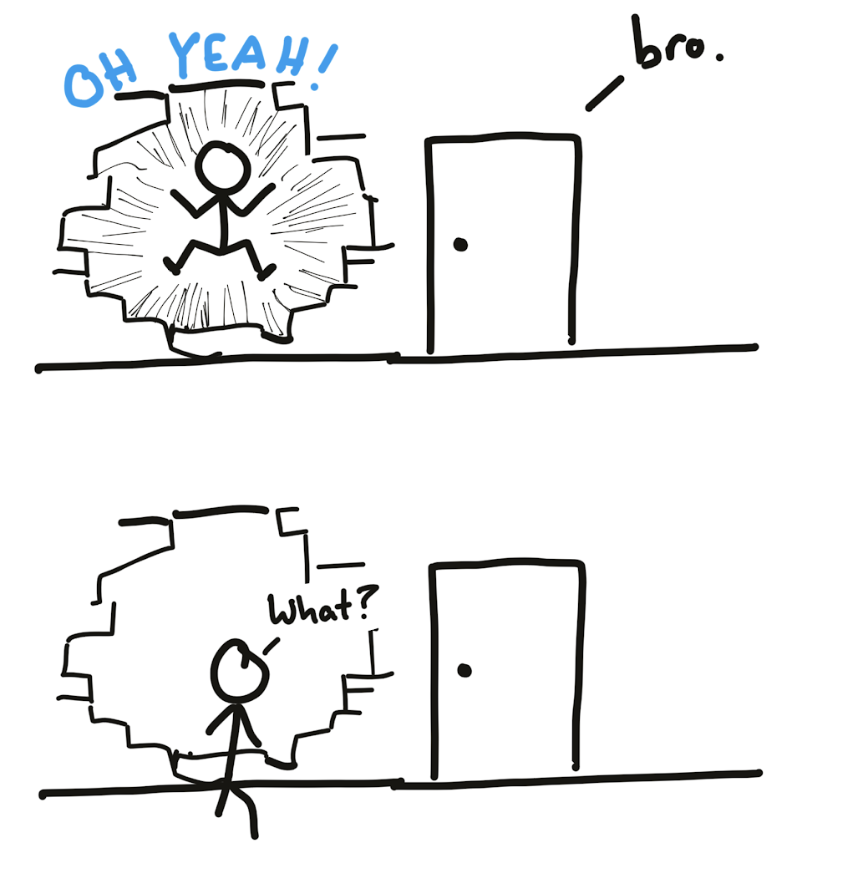
First learn to work hard, then learn to work smart.

Most people never learn the first lesson in life: how to work hard. Like stupid hard. Fewer still move on to lesson two: work smart. And that’s because the first lesson will solve 95% of the problems life throws at you.
It’s hard learning to not work so hard. To high achievers, anything less than 110% feels selfish or like failing or like not caring enough. Similarly, a lot of high achievers struggle with the question, “Have I done enough today?” There start the day with a degree of “productivity debt” that has to be repaid or they’ll feel ashamed, guilty.
But too many don’t even have no answer to what is enough, and so they fill the void with more work hoping that somewhere in the midst of that work, enough was done. When life is ambiguous, the problem is complex, keeping your hands moving your hands, exerting great effort, feels like progress and is enticing.
But let me say this: brute force is a great tactic, terrible stragey. For all the beginner to intermediate levels of the game, brute force is the dominant tactic and a good enough strategy to stay alive. For the higher levels, brute force does not scale well. You start to see people outhinking you and outworking you. You don’t stand a chance.
Strategy to Determine Your Strategy
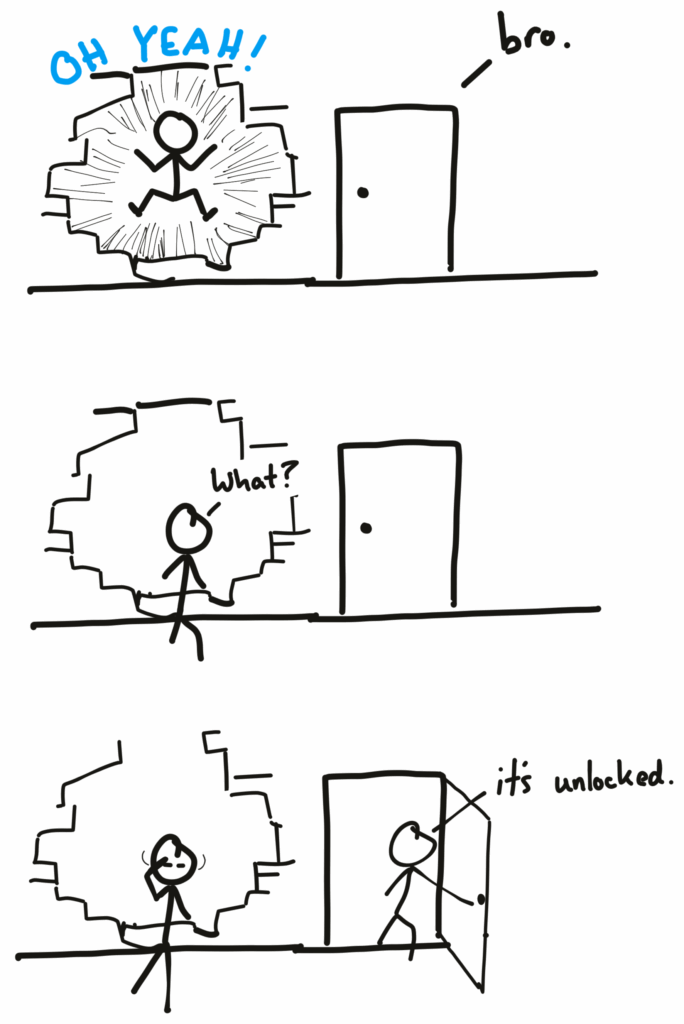
Good strategy sets your direction. With your direction set, then you put your nose to the grindstone and go Kool-Aid Man on that wall. This is why brute force often fails and why no one on the team is trying to outthink the problem. When you start with brute force, you often end up with wasted, directionless effort.
“There’s nothing so useless as doing [well] that which should not be done at all” – Peter Drucker
- Pick a specific goal. That may change as you learn more – no issues. You need a direction to aim at. The more specific the goal the more useful it will be.
- Example: “Improve my deadlift by 30lbs in the next 45 days (list the actual date) and practice the deadlift as a skill for the first 15 minutes of every workout” is more useful than “I want to improve my deadlift in the next month”.
- List all the milestones that need to be hit enroute to your big goal. This is chunking down the big problem into manageable, bit-sized pieces. A useful technique here is backwards planning: if you accomplished you goal, what was the milestone you hit just beforehand? And before that? And then before that? Work your way backwards until you are at the present moment.
- Ordering and Prioritizing. Your backwards planning may still have your sub-goals in the wrong order, so now look at each of them and ask, “which of these if accomplished puts me the closest to my main goal? Which of these has the highest consequence?” DO NOT attempt to several of the goals at once. Parallel execution seems cool but hyperfocusing on one task is often more efficient—better strategy—than multitasking the sub-goals.
- Consequences can be thought of in terms to you, your team, or your team. Ask “what happens if I/we fail?”
- Slap the plan onto a timeline or calendar. Your calendar will get jacked up the second you start trying to execute. Don’t worry about it. You estimating how long each sub-goal will take is an important skill and driving force.
- Say no to all the shiny things that aren’t your current focus. Commit. Remove all other options. Saying no to shiny is a skill.
Other Nuances
1) When your only strategy for life is to work really hard, you will be successful. Having a high work ethic is an extremely valuable and rare character trait—i.e., you’re marketable. However, because of that, there will be plenty of people who want to hire you and direct your life. If you are not careful, you will be rich but will have only lived the life others planned for you. There is emptiness in that Faustian Bargain.
Work hard, but be the one who aims the arrow of your life. Be responsible for where it falls. Take ownership for the mistakes along the way.
2) Undirected hard work results in a lot of wasted effort and some gain.
Experiments:
- Brain dump all of your current goals. Circle the one that would have the greatest impact on making you more of the man or woman you want to be or getting you closer to the dream you want. Ruthlessly pursue that and cut the other options.
- At work, what is the single most important thing you can do for your current project or job? If you don’t have the authority to change the project and steer the ship, plan out the conversation with the person who does. Enjoy the challenge of trying to influence them and the overall strategy for the team.
- Who is the person you care about the most? Could you help them upgrade their strategy? Can you help them grow faster than they are now? Give the gift of trying. Love them enough to get it wrong in the attempt of getting it right.